
A doctor asks you to close your eyes and hold your arms out straight in front of you, palms facing up. Then the doctor watches your arms. If one arm starts to turn or drift downward, that is a pronator drift. This simple test helps doctors check for problems in your brain or nervous system.
The pronator drift test is a common part of a neurological exam. It is quick and easy. The patient does not need any special equipment. But the results can be very important. A positive test, meaning your arm drifts, can signal a stroke or other neurological condition.
Why does the arm drift? Your brain sends signals to your muscles to keep your arms steady. If there is damage to the part of your brain that controls movement, the signals may be weak. Your arm may not be able to hold its position. The palm may turn downward, and the arm may drift.
This test is often used in emergency rooms when a stroke is suspected. It can also help diagnose other conditions like multiple sclerosis or brain tumors.
Let’s explore the pronator drift test, its causes, and how doctors interpret the results.
Pronator Drift
Pronator drift is a popular term in medicine. Also known as pyramidal drift or Barré sign, Pronator drift denotes a pathological sign observed during a neurological test or examination.
It can also be employed as a simple screening tool to evaluate motor neurological pathology. Medical personnel often use this simple but useful screening test to identify potential cerebellar or proprioceptive dysfunction.
French neurologist, Jean Alexandre Barré first described the phenomenon. Hence, the pronator drift is also known as the Barré sign or test.
Other Names
- Pyramidal drift test
- Barré sign or test
- Palmar drift test
- Drift test
- Arm drift test
- Pronator sign
Clinical Significance of Palmar Drift Test
It is a non-invasive screening tool to assess the functioning of the corticospinal tract. So, pronator drift is a sign of corticospinal tract dysfunction.
It occurs due to the weakness of the muscles selectively innervated by the corticospinal tract, the extensors, and supinators. Similarly, this test can also be taken as one of the subtle signs of hemiparesis.
It is a clear sign that the arm’s motor control center on the opposite side of the brain is not functioning properly. The clinical implications can be summarized as below.
- Helps to evaluate motor function in a patient who is awake and able to follow directions
- An important component of the initial examination of stroke as “FAST”
- Single most reliable, non-invasive motor neurological test done before another diagnostic testing, such as CT scan or MRI
- Effective to detect subtle upper motor neuron lesions that might go undetected by routine motor examination
Pronator Drift Assessment
- To access for pronator drift, explain the procedure to the patient. Stand close to him and help him stand or sit on a chair (or raise the head of his bed if he can’t).
- Ask him to extend his both arms out in front of him at shoulder height with palms facing up (as if holding a box with both hands).
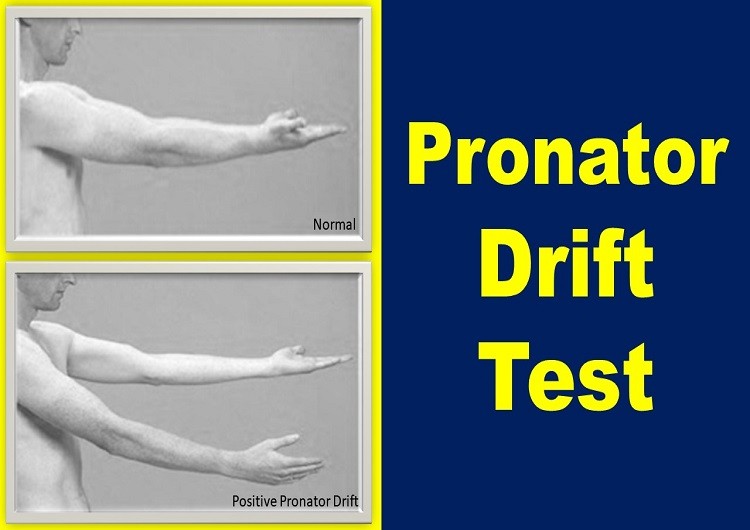
- Instruct him to hold this position and close his eyes. Count to 30 and observe both arms. The patient should maintain this position for 20 to 30 seconds. If there is weakness in one arm, the palm of the affected hand may begin to pronate (palm facing down).
- If the motor pathway of the patient is properly functioning, both arms should remain in this position equally.
Also observe for a lateral or upward drift of arms, which indicates a loss of proprioception (position sense). Tap his arms downward and see the upward movement of his arms.
A smooth return to the horizontal position indicates normal strength, coordination, and proprioception.
The findings of the test are:
Normal
- Hands are horizontal with straight elbows and flat palms, or
- There might be a slight, symmetrical deviation in both palms from the normal position (no downward drift, only pronation). The dominant palm may pronate slightly more than another palm. This is termed a pseudo drift.
Positive Pronator Drift
- Pronator drift is seen in the weaker hand, reflecting contralateral pyramidal tract lesion.
Interpretation and Causes of Pronator Drift
Positive drift with open eyes
Positive pronator drift in open eyes indicates a motor deficit.
Positive pronator drift with closed eyes
Positive pronator drift in open eyes indicates a sensory deficit.
Downward drift and pronation
The downward drift of the arm and the pronation (turn downward) of the palm occur because of the weakness of supinator muscles in the hand due to upper motor neuron lesion.
Drift without pronation
Forearm drift without pronation indicates functional upper limb paresis.
Upward drift and pronation
The upward drift of the arm and the pronation of the palm occurs due to a lesion in the ipsilateral cerebellum or ipsilateral dorsal column.
Precautions
- Perform the pronator drift test for both arms simultaneously. Don’t assess one hand at a time. Bilateral comparison is necessary to determine unilateral or bilateral weakness.
- Perform the test in a normal position. Don’t commence the test with the patient’s arms in pronation.
- Don’t rely solely on pronator drift. Always assess other components of the motor system, such as muscle tone and strength and the patient’s mental status, cranial nerve function, deep tendon reflexes, and sensory function, along with the pronator drift test.
Sources
- Bickley LS, Szilagyi PG.Bates’ Guide to Physical Examination and History Taking. 10th ed. Philadelphia, PA: Wolters Kluwer Health/Lippincott Williams and Wilkins; 2009.
- Dillon, P.: Nursing Health Assessment: A Critical Thinking, Case Studies Approach. Philadelphia, Pa., F.A. Davis Co., 2003.
- Hickey J.The Clinical Practice of Neurological and Neurosurgical Nursing. 6th ed. Philadelphia, PA: Wolters Kluwer Health/Lippincott Williams and Wilkins; 2009.
- Rank W.Simplifying neuro assessment. Nursing Made Incredibly Easy! 2010;8(2):15–19.
- Campbell WW. DeJong’s neurologic examination, 7th ed. Philadelphia: Wolters Kluwer Health/Lippincott Williams & Wilkins, 2013.
- Darcy P, Moughty AM. Images in clinical medicine. Pronator drift. N Engl J Med. 2013 Oct 17;369(16): e20.
YOU MAY ALSO LIKE
Beck’s Triad in Cardiology: Mnemonic, Treatment & More
Cushing’s Triad in ICP: Pathophysiology, Mnemonic, & More
Acronym for Cranial Nerves Mnemonic – Dirty, Funny Tricks
Spermatic Cord Contents Mnemonic – Dirty and Funny
Carpal Bones Mnemonic: Wrist Bones Names in Order
Essential Amino Acids Mnemonic: Ketogenic & Glucogenic
VITAMINS ABCDEK & VINDICATE Mnemonic for Differential Diagnosis
Lines of Zahn: Feature of Arterial Thrombus
FAQs
1. How is the pronator drift test performed?
The test is simple. The doctor asks you to close your eyes and hold both arms straight out in front of you. Your palms should be facing up. You hold this position for about 20 to 30 seconds. The doctor watches your arms. If one arm starts to turn so your palm faces down, or if your arm drifts downward, the test is positive. This means there may be a problem in your brain or nervous system.
2. What does a positive pronator drift test mean?
A positive pronator drift test means one arm turned or drifted during the test. This usually indicates a problem with the opposite side of your brain. The most common cause is a stroke. A stroke damages brain tissue, weakening the signals to your muscles. Other causes include multiple sclerosis, brain tumors, or head injuries. A positive test is a sign that you need further testing, like a brain scan, to find the cause.
3. Can the pronator drift test be false positive?
Yes, sometimes a person can have a positive test without having a serious brain problem. Fatigue can cause your arms to drift. So can weakness from an old injury or arthritis. Children may have trouble holding the position. The doctor considers your whole situation, not just this test. If the test is positive but other tests are normal, the cause may be something simple like tiredness. Your doctor will explain what the results mean for you.